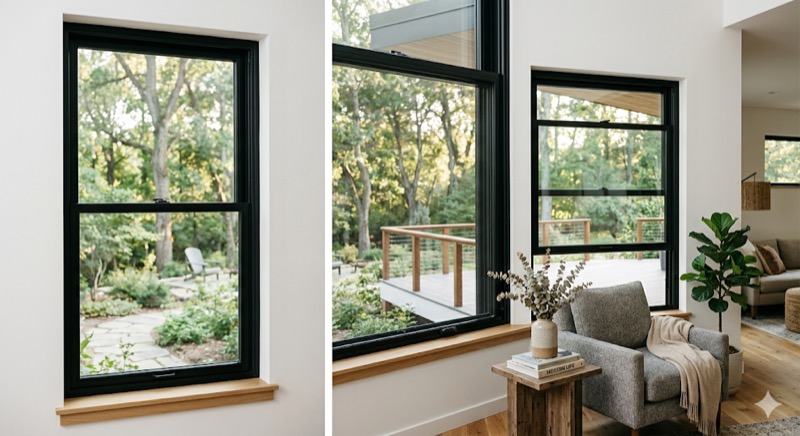
If you've ever walked past an old single-pane window on a 95° August afternoon in Marietta, you already know the problem. The glass is hot to the touch. The blinds are practically radiating heat into the room. Your AC is running non-stop, and your power bill is climbing right along with the temperature.
Georgia summers are uniquely brutal on windows — and on the homeowners paying to cool the air leaking through them. After years of replacing windows across Cobb County, Atlanta, Roswell, and the surrounding metro area, we've learned exactly what holds up to our climate and what doesn't.
Here's what actually matters when you're shopping for replacement windows in Georgia.
Why Georgia is harder on windows than most states
Most window marketing is written for the national market, which leans toward cold-climate concerns: drafts, ice, frost. Georgia has the opposite problem. Our windows have to handle:
- High solar gain — direct sun for 8+ hours a day, much of the year
- Punishing humidity — 70–90% relative humidity for months at a time
- Storm-driven rain — sideways downpours that test every seal
- Pollen siege — fine yellow dust that gets into anything that isn't sealed properly
- Wide temperature swings — 30° mornings and 70° afternoons in spring, then 75° mornings and 95° afternoons by July
A window that performs beautifully in Minneapolis can be the wrong choice for Marietta. The features you want to optimize for here are different.
The two specs that matter most: U-factor and SHGC
Forget marketing jargon. When you're comparing windows for Georgia, two numbers tell you almost everything you need to know. Both appear on the NFRC label (National Fenestration Rating Council) that every legitimate window carries.
U-factor — how well the window insulates
U-factor measures how much heat passes through the window. Lower is better. For Georgia, you want 0.30 or below. ENERGY STAR certified windows for the South all hit this threshold.
A window with a U-factor of 0.27 lets through about half as much heat as a window rated 0.50 — which is what a lot of older single-pane windows score. That difference shows up directly on your power bill in July.
SHGC — how much sun the window blocks
This is the spec that matters most in Georgia and that most homeowners have never heard of. SHGC (Solar Heat Gain Coefficient) measures how much solar radiation gets through the glass and turns into heat in your living room.
For our climate, you want SHGC of 0.25 or lower on south- and west-facing windows. That single spec change can drop your cooling bills by 10–20% on its own. North-facing windows can tolerate slightly higher SHGC because they don't get direct afternoon sun.
Quick rule of thumb for Marietta: U-factor ≤ 0.30, SHGC ≤ 0.25, and the window is ENERGY STAR rated for the Southern Climate Zone. If a window meets all three, it's a contender. If it doesn't, keep looking.
Low-E coatings: not all created equal
Low-emissivity coatings are microscopically thin metallic layers applied to the glass to reflect infrared (heat) radiation while letting visible light through. Every modern energy-efficient window has them.
The catch: there are different kinds of Low-E coatings, optimized for different climates.
- Hard-coat Low-E is best for cold climates. It lets more solar heat in (raising SHGC) so your house stays warm in winter. Wrong for Georgia.
- Soft-coat Low-E (sputter-coated) blocks more solar heat. It keeps your house cooler in summer at the cost of slightly less winter solar gain. This is what you want here.
- Multi-pane Low-E stacks coatings for maximum performance. Premium lines like Vytex Potomac use this approach.
When you're talking to a window salesperson in Georgia, ask point-blank: "Is this soft-coat Low-E rated for the Southern climate zone?" If they hesitate, walk.
Frame material: vinyl wins for most Georgia homes
You've got four main options for window frames, and they each handle our climate differently.
Vinyl is the clear winner for most Marietta homes. It doesn't rot, doesn't warp in heat, doesn't absorb humidity, and modern vinyl frames have excellent insulation values (the hollow chambers act as additional thermal breaks). Maintenance is essentially zero. The only real downside is that the cheapest vinyl can look obviously plastic — but mid-tier and premium lines look beautiful.
Fiberglass is more dimensionally stable than vinyl in extreme temperature swings, and it can be painted. It costs more, and for Georgia's climate the performance gap over good vinyl is small. Worth considering if you want a paintable frame or have an unusual installation.
Wood is gorgeous and historically authentic. It's also a maintenance nightmare in the Southeast. Humidity warps it. Termites love it. Direct sun cracks paint within a few years. We don't recommend wood frames for Georgia exterior windows unless you're restoring a historic home and you've budgeted for ongoing upkeep.
Aluminum conducts heat. In Georgia, that's exactly the wrong property — your aluminum-framed windows will become heat bridges in summer, transferring outside heat directly into your house. Avoid for primary residences.
Don't forget the install
Here's the thing nobody mentions in the brochure: a great window installed badly performs worse than a mediocre window installed well.
We've pulled out brand-new "premium" windows that were leaking air around every edge because the installer didn't properly flash the rough opening, didn't use the right shim points, and stuffed fiberglass insulation into gaps that needed expanding foam. The window itself was top-shelf. The installation killed every benefit.
When you're getting quotes, ask about:
- Flashing tape around the rough opening (not just caulk)
- Low-expansion foam in the gap between window and framing
- Backer rod before the exterior caulk bead
- Pan flashing at the sill of every window
- Manufacturer-certified installers — most quality brands have a certification program
A contractor who can talk fluently about all of these is one you can trust with your home. One who can't probably won't install the windows correctly no matter what brand you buy.
What we recommend for typical Marietta homes
For most homes in our service area — built between 1985 and 2010, replacing original builder-grade windows — we generally recommend:
- Vinyl frames (mid-tier or above)
- Double-pane insulated glass with argon fill
- Soft-coat Low-E rated for Southern climate
- U-factor ≤ 0.28
- SHGC ≤ 0.25 on west and south exposures
- ENERGY STAR Southern Zone certified
- Lifetime warranty from a manufacturer that's been in business at least 20 years
That combination handles Georgia summers without breaking the budget, qualifies for federal energy efficiency tax credits, and typically pays for itself in energy savings within 10–12 years on a typical-sized home. After that, it's pure savings — every month, for as long as you own the house.
Ready to upgrade?
We replace windows across Marietta, Atlanta, Roswell, Kennesaw, Alpharetta, and the rest of the greater metro area. Every consultation is honest, no high-pressure sales, and every install is backed by our lifetime warranty.
If you're tired of cooling the outdoors, give us a call or request a free quote. We'll come measure, look at your specific exposures and home situation, and give you a straight answer on what would actually work best for your house.